May
03, 2013

As debates around the state transportation bill heated up this month, we teamed up with the Transportation for Massachusetts Coalition (T4MA) to create a series of infographics that capture the complexity of the Bay State’s transportation network. Since most of the Fathom team commutes via public transportation (the rest bike to work), we felt strongly about contributing clear and readable graphics that could be used in the course of the T4MA advocacy campaign. We have a vested interest in seeing that network remain in good working order, accessible, and affordable.

We looked at dozens of datasets relating to The Way Forward (TWF), a ten-year financing plan proposed by MassDOT in early 2013.  Our challenge was to take the budgets, pro formas, development plans, and proposed legislation relating to TWF and create a set of assets that could be used flexibly by T4MA and other advocacy groups as the plan made its way through the legislative system. One day an infographic might be dropped into a PowerPoint and used in testimony at the State House, and the next it might be printed in a brochure and distributed to the sixteen Regional Transportation Authorities (RTAs) in the state, so the design needed to be adaptable. From the beginning, we focused on how these proposals would impact Massachusetts as a whole. With Boston’s transportation network dominating the rest of the state in terms of size and expense, it is easy to see how residents of Western Massachusetts, for instance, could feel like all of their tax dollars flow eastward. We took special care to find and highlight examples of regional equity in the proposed plan.

Chapter 90

Chapter 90, or apportionment funding, refers to the money distributed by the state for capital improvement projects in highway construction and preservation. A key part of the MassDOT plan called for increasing apportionment statewide from $200 million to $300 million each year. Each town’s percentage of road miles, population, and employment is factored into a formula that determines the amount of the statewide apportionment it will receive. We measured the level of funding each region would earn based on its density of road miles, and found that in both urban and rural areas, increasing the statewide apportionment would enable improvements in roads, highways, and bridges across Massachusetts.

Increasing the Ch. 90 Apportionment from $200 million to $300 million would allow for significant roadway improvements across all regions of the state.

Increasing the Ch. 90 Apportionment from $200 million to $300 million would allow for significant roadway improvements across all regions of the state.

Regional Transportation Authorities (RTAs)

During a conversation with the folks from T4MA, we discussed how investment in public transportation is also, in a way, an investment in improving other regional infrastructure. The availability—or infrequency— of public transportation can determine who has access to certain jobs, schools, hospitals, and other institutions. We were compelled to create a graphic that illustrates the disparity of public transit in different regions of the state. The variance of operation hours within each RTA testifies to the need for more dependable, regular hours for bus services statewide.

Due to insufficient funding, many of the regional transit systems are unable to provide service in the late evening and on weekends. Short service hours are problematic when people in certain areas of the state—especially in economically depressed areas—don’t have the means to access job sites, schools, healthcare facilities, grocery stores, and other locations that are part of a daily routine.

Massachusetts Operations Funding

How do state revenues actually make their way to transportation agencies? The way money flows through any state is complicated, but in Massachusetts things are particularly complex. Using data from a recent MassDOT budget hearing, with input from researchers at the Dukakis Center for Urban and Regional Policy at Northeastern, we generated a picture of where the state’s transportation revenues come from, and what financial structures they move through as they make their way to their intended sources. The overwhelming takeaway for us was that almost half of the state’s revenue goes toward paying off existing debt.

 The Commonwealth Transportation Fund (CTF) is subject to appropriation by the MA legislature, which mandates that revenues be put toward debt before funding the MBTA or the RTAs. In the past, this has meant that there is not enough funding left to maintain a state of good repair (SGR) within the Commonwealth's roads, bridges, and railways."
The Commonwealth Transportation Fund (CTF) is subject to appropriation by the MA legislature, which mandates that revenues be put toward debt before funding the MBTA or the RTAs. In the past, this has meant that there is not enough funding left to maintain a state of good repair (SGR) within the Commonwealth's roads, bridges, and railways.

MassDOT

The Massachusetts Department of Transportation oversees (among many things) the state’s roads and highways, coordination of the sixteen RTAs, and maintenance of vehicle registration records. We looked at pro forma budgets released by the state and built a picture of what MassDOTs revenues and expenses will look like over the next few years. (It should be noted that the pro forma projections extend to the next twenty-five years, but we chose to focus on the immediate future.) The current fiscal year benefits from a small budget surplus in 2012, but as additional development projects come online, significant revenue gaps start to form from 2014 onwards.

Red hashed lines indicate the gap between revenues and expenses for each fiscal year. Even if MassDOT minimized its operating expenses, the state would still need a solution for its growing debt.
We then zoomed in on the year 2015, on the far right, to take a look at the exact line items that contribute to these totals. On the revenue side, the bulk of funds come from the state sales tax, gas tax, and fees from vehicle registration. On the expense side, the majority goes toward paying off old debt.
A detailed breakdown of where the money goes in a typical budget year.

Where we stand

The Way Forward called for $13 billion in additional funding over the next ten years. $684 million was needed to simply operate the transportation network we have today, roughly $5.2 billion to invest in road and bridge upgrades across the state, and $3.8 billion in transit expansion projects to bring economic growth and stability to targeted regions. The plan provided detailed accounts of the state’s financial needs, but nothing of the details of its ongoing implementation. The monumental challenge of raising even a fraction of that money remains with the State House, and has been a source of contentious debate. In early April, the Massachusetts House passed a bill providing $500 million in additional funding, while the Senate passed a version with $800 million a few days later. The bill is currently being reviewed by a joint conference committee.

In the meantime, we’ll keep doing our part to fund transportation improvements—one CharlieCard tap at a time.

May
01, 2013

How much geography can we do without?

Written by: terrence 

I am fascinated with metro maps. You may be more familiar with the term “metro” as the T, subway, L, Underground, Tube, Tram, BART, Muni, Subte, T-bana, U-bahn, Tren-Urbano, SkyTrain, MTR, Tren Electrico, T-bane, S-tog, Rapid, and even Clockwork Orange depending on your home city.

I visited Amsterdam in the winter of 2010, and arrived during a blizzard. As you may know, the city has a progressive approach to transportation. The center of the Amsterdam is car free, and the city hosts more bicycles than permanent residents. The above-ground tram system services the metro area. I hopped on the tram and began navigating “towards” the hostel. The snow was heavy, and the fact that we were above ground was not of any help. I began thinking how the awkwardly large map I was given could be improved, first by finding the closest recycling bin. For the remainder of the trip, I was much more successful navigating by verbal directions, and referred back to the map only for the pronunciation of station names such as “Van Kinsbergenstraat” and “Haarlemmermeerstation.”

That spring I designed a map of the Amsterdam tram. It was my first attempt at abstracting geography. I used tracing paper, and retraced the lines over and over to create a structure that I later scanned into Illustrator. The process left me with a couple thoughts. First, when do I know I have reached a level of abstraction that no longer relates enough to actual geography? Secondly, there is no possible way tracing paper is the future of metro cartography.

Diagram maps forgo all spatial integrity and instead represent the connectivity of a specific environment. Diagram metro maps tend to space elements at equal distances, so while they manipulate geographic distance, the routes are more readable to the average user. In the case of a metro map the lines representing rails will adhere to design rules in order to be uniform (e.g. they might only make 90/45 degrees turns). Landmarks are often added to help with orientation.
Topological maps forgo all spatial integrity and instead represent the connectivity of a specific environment. Topological metro maps tend to space elements at equal distances, so while they manipulate geographic distance, the routes are more readable to the average user. In the case of a metro map the lines representing rails will adhere to design rules in order to be uniform (e.g. they might only make 90/45 degrees turns). Landmarks are often added to help with orientation.

About a year later, after becoming more familiar with Processing, I began exploring the balance between geography and readability. I needed longitude and latitude data, so I went to Alex, our own head of GIS mapping. She used an open-source program called Quantum GIS to compile coordinates of the MBTA and commuter train stations and railways. Mark and I worked on the sketch using the latest version of Processing. Later we ported the project to JavaScript so that I could share it with you.

Geographic maps preserve one of four spatial elements: distance, direction, shape, or area. They are a representation of a three-dimensional world on a two-dimensional plane, and while they may try to represent elevation, rainfall, temperature, or another location-based metric with full accuracy, a certain geographic element is always compromised.

Although the tool is interactive, I should note that I had a static map in mind for the end result (i.e. a single image that could be used to navigate the entire city). A static map has its constraints because it tries to be everything to everyone. Metro maps are often designed as still images, while mobile apps curate the information down to what one really needs to know. It is my personal belief that a static map will continue to stand at the center of a more complex system of navigation, just as a logo is the heart of an identity system. My hope is that this exploration serves as a process tool, teaching example, or even aid in a conversation about New York City’s MTA map history.

If you see any errors it would be great to hear about them (drop us an email: inquire at fathom.info). Station coordinates (last updated 2/2/12) and hydrography (last updated 3/15/13) are from MassGIS. Geographic data for surrounding states is from the U.S. Census Bureau, Geography Division, and were last updated 1/31/2012.

April
30, 2013

When you have young children, at some point you will probably need to come to grips with the idea of vacationing at Disney World.

Zoom-in on Disney's Magic Kingdom
The stats for how we spent time at the Magic Kingdom during our vacation

On the one hand, Disney spends an enormous amount of effort creating memorable experiences for kids. On the other, they are behind one of the most relentless marketing efforts aimed at people too young to think critically about what they are seeing. But doesn’t going to Disney World exemplify putting your children’s interests before your own? But doesn’t Disney World exemplify crass consumer culture? But it’s fun for the kids! But it’s warping their minds! Yay! Nay!

Landing firmly on the grumpy side of that spectrum, I was less than excited when it was decided that my family would be spending a week in Orlando. Other than the whole watching-my-kids-have-fun thing, how could I make this trip more enjoyable? And how could I bring some objectivity to any further discussions on this topic? The answer came to me in a flash: data! I would pick up the torch of Fathom self-quantifying and track the amount of time we spent in line verus the time we spent on rides. With time running out, I whipped together a web app for my iPhone that allowed me to track the entry, exit, and waiting times for each family member on each ride. The app even included a way for the folks at the home office to leave messages for me. Now that my phone could help me track the ratio of waiting time to fun time, I was ready to go.

mark-iPhone
The custom interface for tracking rides, passengers, and wait times while on vacation.

The data collection stage of the project (a.k.a. “the vacation”) went smoothly. We spent three days at Disney parks, and one day at Universal Studio’s Islands of Adventure (to satisfy the Harry Potter fans in the family). At the gate of each park, ride, or show my wife and I tracked the time we got in line, the time the entertainment started, the time it ended, and which kids were with us. I will admit that sometimes the timing was off: on the water rides, for example, the accuracy of the data did not merit a new phone. To further complicate things, whenever I tried to enter data with one hand, the other was yanked by someone who didn’t share my priorities of data entry. Thankfully, being close to the data meant that I could clean it up a bit when we got home.

We got to the park before opening in order to hit the rides before crowds built up. Our planning may have skewed the final wait/fun ratios. We also took advantage of Disney’s Fastpass system, which allows you to bypass some lines in favor of coming back later at a scheduled time. This wasn’t included in our tickets to Universal, which was one factor in the larger wait times there. You can see for yourself in the application I made based on the results.

Circles, words, lines
Visualization of time the author’s family spent waiting vs. riding at amusements parks in Orlando, FL. Larger circles indicate more time spent at a ride or park, and the width of the pink band indicates how much time was spent waiting. See the interactive version here.

In the day view, you can see the complete schedule of when we were at the parks, when we were waiting for rides, and which rides we were on. In the park view, you can see how many times we went to each park and ride, with the tallied fun time vs. wait time.

For what it’s worth, this is in no way intended to be a recommendation of which park has longer or shorter waiting times or which is the most fun. This is merely a reflection of how we chose to spend our time given the choices available to us when we visited each park. And does the wait time even matter? Despite only spending about seven minutes on the ride, my daughter said Space Mountain was, “Awesome with a capital A-W-E-S-O-M-E and googleplex exclamation points!” Does it get much better than that?

After all this, am I less grumpy about Disney’s influence on my children? I’m not going to write here about that. To find out, you’ll have to catch me in person. But don’t worry, it’s a small world.

April
18, 2013

Thomson Reuters released their 2012 Annual Report online last week. While VSA Partners designed and implemented the site, we worked on a set of five graphics that highlight a selection of Reuters’s core business units.

What Can Market Sentiment Tell Us?

We used the MarketPsych Indices, a component of Thomson Reuters News Analytics, to represent the rise and fall of various sentiments across different countries and regions. The indices measure human emotion reflected in news and social media sources; that information can then be used to inform investment and trading decisions.

To begin, we worked through more than one hundred countries and thirty-four types of sentiment, finally deciding to highlight the eurozone financial crisis and the role of Greece within that crisis. (Greece, hard-hit during the global financial crisis of the late 2000s, requested financial aid from the EU and the International Monetary Fund in 2010, which triggered a decline in the value of the euro.) The graphic below compares sentiments about Greece during the financial crisis with sentiments concerning the eurozone in general. By pairing the emotions of fear and optimism with the more concrete concepts of debt default and market risk, we were able to illustrate how opinions about Greece rippled out to other eurozone countries. We annotated specific peaks or dips in sentiment with descriptions of the events that prompted those changes.

What Can Market Sentiment Tell Us?
Heavier lines depict the monthly moving average of sentiment, while the noisier raw daily values are plotted with lighter transparent lines in the background. Using both sets of numbers allowed us to keep the detail of daily variability while focusing on the overarching trends regarding the eurozone crisis.

A Small Planet Seeks Big Ideas

Environmental and social governance (ESG) policies are a means of measuring “sustainability and ethical impact of investments.” We were asked to investigate the status of such policies from three angles. First, what percentage of corporations worldwide, by sector and by country, adopt these policies? Second, are companies that adopt resource-use policies more likely to report their consumption and emission figures? Lastly, does increased transparency—public reporting of these figures—result in a more efficient use of resources?

For both water consumption (shown) and carbon emissions, the length of each bar shows the percentage of companies that publicly report their resource use. The sectors (left column) and nations (right column) with the greatest ESG policy adoption are listed first.

The level of regulation for corporate reporting varies within countries and sectors. Using ASSET4, a curated database of public ESG information, we were able to explore the connection between resource policy adoption and the level of reporting for corporations around the world. We found that companies with resource-use policies in place were also more likely to make their consumption and emission figures public.

We asked our contact at ASSET4 to share his insight on the third question—whether increased transparency could be correlated to more efficient consumption and emissions. His response was something along the lines of, “If I could answer that…I’d be sipping cocktails on a beach right now.” We may not have the million-dollar answer yet, but we’re hopeful for the day when that correlation can be made (if not for environmental reasons, then at least so we can mix drinks with our friends at ASSET4).

High Cost and Pace Drive Collaborative Science

The structure of academic funding, as well as the rise of communications technology, has fueled dramatic shifts in the academic publishing landscape. We explored these shifts using the Web of Knowledge, a database of academic publishing that contains rich metadata about authors, locations, and funding sources for each project.

The paper with the greatest number of authors in the dataset was in physics, published in 2011 with 3,220 authors.

We began by looking at the distribution of author counts for papers across academic fields. We were surprised to find that single-author papers are actually in decline, and the growth of two- and three-author papers (depicted in the gray plots along the top) is slower than that of papers with more authors. The larger image focuses on the rapidly expanding slice of papers with ten or more authors, both highlighting their increasing frequency and which academic fields are fueling the trend. While much of the popular discussion about collaboration centers around fields like physics, where we’ve heard a great deal about large teams and even larger equipment, the data also revealed that clinical medicine has consistently led the progression toward multi-author research.

Finding the Balance in the Business of Law

The Peer Monitor Index (PMI), a quarterly indicator of trends in the legal field, is a proprietary metric derived from an annual survey of legal firms and corporate counsel departments. The index is calculated from a set of weighted measurements of the rates, direct expenses, overhead expenses, demand, and productivity reported by survey respondents. With a rise in direct and overhead expenses and a decline in demand and in-house productivity, the PMI has dropped below healthy operating levels since the second quarter of 2007.

We wanted to show how legal entities are addressing changes to the their field. In order to add context to the PMI metric, we incorporated survey data from the Association of Corporate Counsel. This data suggests that legal firms are turning to legal process outsourcing (LPO) to cut overhead costs and raise productivity.

With an increasingly competitive legal landscape, corporate legal departments and legal firms see legal process outsourcing as an attractive way to reduce overhead costs.

Can Land Rights Deliver Peace & Prosperity?

In developing nations, documenting and protecting land rights is a challenging but essential element of the formula for economic growth and social stability. Hoping to promote the maintenance of more accurate records of land ownership, Thomson Reuters has worked with local governments in some of these countries to implement their land management platform, OpenTitle.

Countries in Africa, eastern Europe, and central Asia have seen the most significant improvements in the cost to register property.

In order to show land rights from a global perspective, we turned to publicly available data from The World Bank, which collects (among many things) global metrics on land rights. To see where conditions were improving, we mapped the cost, length of time, and the number of steps required to register property in each country since 2005. According to the data, the ease of ownership has improved the most in developing nations. Dark purple indicates where the cost of registering land has decreased in the last seven years. Callouts highlight nations where OpenTitle is used.

April
12, 2013

The Ides of Insanity

Written by: fry 

For the past several years, my three brothers and I have convened at the eldest brother’s house for the first weekend of the NCAA Tournament (also known as March Madness), doing our best to watch as many of the initial 32 games of the tournament during a melba toast and orange juice-soaked* four days of disregard for the outside world. Over time this has evolved—it initially started with just the two oldest brothers in an Arizona basement—into a gathering of up to two dozen friends, neighbors, wives, and kids.

Naturally, this group has also run an annual bracket pool, with everyone making their picks and competing to see if they can win some cash dignity and respect from the rest of the group. In the spirit of overdoing it (and working during what should be a vacation), for several years I’ve been building software that ran the pool and allowed people to track their picks, see how they were doing against everyone else, try out scenarios for future games, and talk smack to each other through a chat feature.

So this year, in the spirit of really overdoing it, Fathom Bracket was born. (There’s a lot of this going around: after all, as I write this post, Mark is spending the last day before his vacation writing a tool that will let him record data and update his status during his family’s week at Disney.) Tim took the helm of Fathom Bracket and built out the infrastructure to make it happen (a combination of Django, Postgres, and Redis, as well as lots of front-end JavaScript and CSS) and the rest of the team went to work on the design, development, writing, and testing. Alex in particular has distinguished herself as QA engineer, creating hundreds of alex, alex123, and alex1414093 accounts and test pools, mostly variants of “Dirty Pool.”

Once publicly launched, Fathom Bracket hosted a number of pools set up by individuals, plus the public “City Pool” that anyone could join, which picked up a few dozen entrants. After Louisville’s win was celebrated** by a flaming basketball animated GIF created by Terrence, there was a three-way tie for the City Pool, with “jlbaseball2,” “sistersarah,” and “Seth’s Winning Bracket” (named with a degree of prescience, it seems) coming out on top. They’ll each be receiving an allstreets or dencity poster from our Provender vault.

Best of all, we came up with a number of ideas for a better bracket as part of the exercise, and we can’t wait to get them implemented for next year’s tournament.

In the meantime, we have to get back to work. With Mark out of town next week, someone is gonna have to pick up the slack.

* It’s possible it wasn’t melba toast and orange juice, but that’s how Brother #1 referred to it at the time.

** To the disappointment of the four Michigan-born Fry brothers.

March
20, 2013

Spring Psychosis

Written by: alex 

Friends, foes, and country people: we would like to cordially invite you to experience the Fathom Bracket (2013 March Madness edition).

Before the first tip-off on Thursday, you can start a pool, submit your picks, and trash-talk other players in your group. Picks will automatically lock on Thursday at noon (to guard against changes of heart based on, say, the final scores of each game).

Feel like you’ve already made too many enemies this month? No problem—Fathom’s City Pool is opening its doors to the general public. As the Round of 64 gets moving, the site’s live bracket view will maintain real-time scoring, wins, and losses. It will also support scenario testing and, of course, the beloved riffraff of the Smack Talk Box.

Rumor has it President Obama and Kid President are submitting picks too, so hop on in at http://www.fathombracket.com

BlogPost

Note: Our site doesn’t support gambling, but the folks who made it aren’t exactly against it either. Play ball!

March
13, 2013

Rising stars and many hats

Written by: mark 

This post continues from “Of guanxi, kingmakers, and princelings,” describing how we approach projects and let the data inform the presentation. You may want to read that one first. 

From the outset of the Connected China project, initial discussions with Irene Jay Liu of Thomson Reuters told us that the career trajectories of Chinese officials would play a major role in the application.

In the custom database maintained by Irene’s team, a job is tracked as a relationship between a person and an organization. Memberships, academic affiliations, and person-to-person connections are stored in the same way. To better understand these connections, we built a quick tool to explore them along a timeline:

Connected China Relationship Explorer
In the data compiled by Reuters journalists, every type of connection between people, organizations, and events is assigned a specific relationship type. Particularly interesting is the time span attached to each link.

The database allowed the journalists to track the duration of every relationship, but durations were most readily available and reliable for official positions. As a result, we focused on the rise and fall of political careers. And what better careers to explore than those at the very top, the members of the Politburo Standing Committee?

Officially known as the “Standing Committee of the Political Bureau of the Communist Party of China Central Committee,” the Politburo Standing Committee (or “PBSC”) is China’s most powerful organization. Their decisions trickle down through all levels of the Party and through the government and military. Our next step was to isolate the positions held by the PBSC’s nine members (in November, this number was decreased to seven). You can see the members listed across the top of the screen capture below, and underneath them you can see Li Keqiang‘s full career history as it appeared in the database at that time. Each of the rows with a red, orange, or yellow square mark a position he has held, and each black bar is a rough timeline showing the duration of the post.

PBSC Roles
In the summer of 2012, China’s top ruling body still had nine members. Each of them held multiple positions in the government and, more importantly, in the Communist Party.

One immediate observation we made was that a politician can wear many different hats at the same time. In the snapshot above, almost all of Li Keqiang’s positions within the Chinese Communist Party and the executive branch of the government are being held concurrently.  As officials climb the ladder, they usually take on parallel positions in the Party and in the government, and they frequently hold several offices in addition to their primary role. We would come back to those simultaneous positions later in the process. Before that, we had to find the means of showing career advancement.

How detailed could we be about career advancement? Even jobs that aren’t necessarily superior on paper represent an advance in status and experience. While the journalists researched official sources for ranking civil service positions, we built a quick tool to put the various jobs in a fixed order. We then plotted the careers of the members of the PBSC, first indicating the type of positions they held in a grid and then expanding those positions into a timeline. We also wanted to acknowledge the impact that age has on careers—the Party and the government enforce retirement ages, so politicians who get a late start might never achieve top leadership. So we added the option to align the timeline by age, which you can see in the video below around the :08 mark.  We collapsed the jobs to show only the most important ones during their careers.


Many of these ideas made it into the final Connected China app, but plotting each position as an incremental rise or fall in career importance did not. Because not all positions are easily mapped onto ranks, too many of the steps involved an “unknown” change in status, which made comparisons difficult. Sometimes, it can be hard to say goodbye to an idea, but we knew comparing careers would need to be straightforward for an audience not concerned with the nuances of roles and rank.

Some positions within the civil service are assigned ranks or administrative levels. Unlike in the United States, where a presidential candidate can be a U.S. senator, a state governor, a business leader—or even an actor—political advancement in the Chinese system tends to follow a prescribed pattern. Officials start off with local positions, then advance to the provinces, and then step onto the national stage before they can rise to the Politburo Standing Committee. Most serve in a deputy role at both the provincial and national levels, but some, like the President Xi Jinping and Premier Li Keqiang, rise quickly enough to skip those deputy roles.

In order to plot a politician’s rise, we needed to map each of their roles to its correct administrative level, and then collapse all of their simultaneous roles beneath the most important position. Since the reporting team was still in the process of researching and entering positions in the database, it was time for another iteration to make sure we were showing career growth accurately. In this one, we showed both a full career history on the right, and a timeline of corresponding administrative levels on the left:

Admin Level browser
In the Chinese civil service, ranks are assigned to many of the positions. Career trajectories proceed along these ranks in consistent ways.

Once we had the fundamentals worked out, we set aside our internal tools and started work on what would become the final application. We determined that the full list of roles and the steps in a career told necessary—but fundamentally different—stories, so we handled them in two different ways. In the Career Comparison view, the ability to compare multiple careers far outweighs the need to see the specifics of a political post. Initial testing showed this career comparison to be an important window into understanding the subject at hand, and as a result, it became one of just five top-level sections in the final application.

Three Presidents in Connected China
Three generations of Chinese presidents in the Career Comparison view of Connected China. Retired Jiang Zemin is in green, Hu Jintao is blue, and new President Xi Jinping is in gold. Each path features a steep rise and jumps over one or more administrative levels.

On the other hand, the full career history is used to round out an individual’s profile, where it’s more appropriate to show the additional detail of their career.

Xi Jinping's career history in Connected China
Xi Jinping’s career history, as shown in his profile page in Connected China. Wide bars denote positions he holds currently, and color denotes the rank. Here, his most important role (leader of the Chinese Communist Party) is highlighted.

By toggling the different checkboxes at the bottom, you can highlight an individual’s positions within the Party, government, military, and roles from other categories. Swiping (on a tablet) or dragging the mouse (on a desktop computer) across each position will show details such as rank and the official name of the post. The wider bars indicate currently held positions—emphasizing the tendency for top officials to hold many positions at the same time.

These simultaneous offices are one mechanism by which the Party, the government, and the military act in concert. In the Institutional Power view, we provide a map of the these pillars of power, and in step two of the introductory guide we highlight the positions held by the members of the Politburo Standing Committee. As you tap or move your mouse over each member, all of their current positions are highlighted in red. Below, you can see the positions currently held by Xi Jinping, head of the Communist Party and incoming president. You can see he is at the very top of the party and the military, and currently serving as vice president within the government.

Roles held by PBSC members in Connected China
Chinese officials often serve simultaneously in the Party, government, and military. In the Institutional Power view, we show the top tiers of all three pillars and the roles held by members of the Politburo Standing Committee. Here, all the positions currently held by Xi Jinping are highlighted in red.

The ongoing efforts of the Reuters journalists continued to uncover more details about political posts and connections during our development process.  And by using that data to inform the tools we built as part of the process, we were able to weave useful information about political careers throughout the application.

March
08, 2013

Disconnected China

Written by: terrence 

Working digitally has some similarities to the physical world. For example, when painting, brushes can break down, lighting can change, and models can shift. Often these variable forces have interesting visual results. We’ve collected a handful of our favorites from the Connected China project. This first image is the result of Katy testing out the homepage on Windows through VMware:

bug-homepage

The next two bugs were caught by our own Mark Schifferli when we lost him to the cavernous org chart. Upon resurfacing, he had captured this shot of “The Central…Xi Jinping.” “The Central Committee” had been shortened with some comically large text that didn’t fit properly. This happened back in July 2012…a foreshadowing of Xi’s election as the new top leader of China in November 2012!

cc-bug-the-central-xi-jin

Cool uninformative things get framed and sold as is:

cc-bug-X

Here’s the loading nonagram (replaced by a heptagram when the number of members on the Politburo Standing Committee was reduced from nine to seven), a spiraling animated image, without the css rule [background-repeat: no-repeat;]. Especially dizzying when they are all rotating simultaneously:

Screen Shot 2012-09-04 at 11.57.49 AM

This last image isn’t a bug, but it gives a glimpse of the artistry behind UI critiques we share with each other. Magenta has an important role when we are marking up comps; however, this creeping hand by Jimbo Grady was a first and favorite. We suspect this won’t be the last time we see the pink arm of doom (with French cuffs) added to a mockup.

magentaHand

March
07, 2013

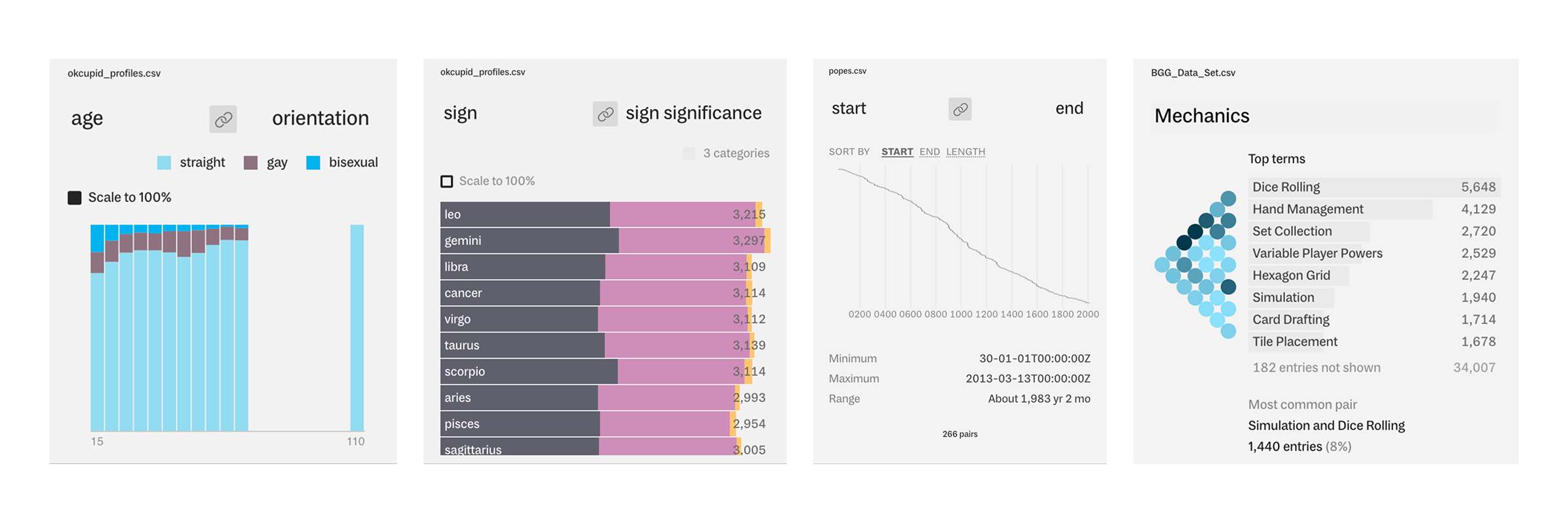
All of our projects start with a data set. As we begin designing a piece, we poke through the data to see how clean it is and what sort of stories it will support, and we investigate what form the final piece could take: is it an app? an exploratory tool? an infographic? At this stage, we’ll use various languages or tools (Processing, Python, Excel, and R tend to be the most common) to build custom software that will help us interact with the data and test our ideas about what the data contains.

From our first meeting with Irene Jay Liu where she laid out the plans for Connected China, we knew this would be an expansive data set. What she proposed would have both breadth and depth, and we were excited about working with Thomson Reuters’ team of journalists as they filled it out. The stories that they wanted to demonstrate with the data — the primacy of the Communist Party, the standardized path of the rise to power, the influence of accumulated social capital — would all require unique representations. We were eager for the challenge, but first we needed to familiarize ourselves with the data. At this point, we were working with data in draft format that wouldn’t see final approval for a few months.

One of the first challenges was how to portray guanxi (关系), the influence of social networks. The typical way to represent this would be in a graph where people are clustered according to the closeness of their relationship. However, most social graphs do not typically include an explicit measure of how tightly linked two people are. That affinity is calculated by an algorithm that traverses the relationships in the network, often looking at the links they have in common to infer how close they are. While affinity can make for an interesting presentation, we felt that the hand-curated data for the networks of China’s top leaders would support something more customized, and that there were more interesting stories to tell.

As part of their research, the journalists at Reuters qualified each connection with a specific relationship type, such as Mentor, Ally, Colleague, or Mishu (秘书). The nature and variety of these relationships provided a much better measure of affinity than an algorithmic model would provide. That prompted us to drop the idea of a graph based on clustering and look for different organizing principles for our network layout.

When we started looking at China’s top leaders, it quickly became clear that we wanted to feature degrees of separation. Most party officials are either one or two degrees away from a former top leader. These retired leaders, known as kingmakers, continue to exert tremendous influence through their protégés. So our first exploration of the social relationships in the Connected China database was a simple tool that allowed us to center the network on a person, then choose how many degrees of separation to show:

Degrees of separation in social networks
Rather than grouping people by their modeled affinity, we chose to show the degrees of separation in the social network. This early draft uses a white box to represent each individual and includes groups and factions in yellow, and the network is centered on the Shanghai Clique. Boxes here are sized according to the number of connections, a metric we abandoned later and replaced with an indication of actual power.

This sketch confirmed that only a few degrees were needed to convey the interwoven connections of Chinese top leaders. For example, each of the current members of the Politburo Standing Committee has at least one kingmaker among their first-degree connections. Whenever working with a network such as this, an early goal is to find ways to simplify it based on how it will be used, rather than showing a visually complex — but mostly useless — hairball of connections.

We settled on two degrees in our next iteration, and our next step was to highlight the detail behind the relationship types. In addition to using those types for grouping people within the first and second degree, we wanted to emphasize the influence of family connections. The offspring of early communist leaders are known as princelings (太子党), and many of them have benefited from the prominence of their parents by landing leadership roles in government and business. We highlighted this in two ways. First, we placed the family members to the left of the person at the center of the network (called the “ego”). Second, we put anyone with a relationship to an ego’s family member in the first degree, right alongside the people with direct relationships to the ego (although we kept them a different color).

Early Draft of Xi Jinping's Network
Two degrees of separation are enough to reveal how closely linked China’s top leaders are, especially when we automatically include family connections. Xi Jinping is the large blue dot at the left, and behind him are his family members in grey and green. The column down the center of the screen represents people with direct connections to Xi Jinping (blue) or his family (green), and the lines that connect them pass through labels indicating the relationship type. The second degree is listed towards the right, and includes some red dots to indicate rivalries.

Despite some clutter remaining, by this point we knew we had worked out the organizing principles for the network layout. There remained one more item that we wanted to show, and that was a measure of each person’s overall importance in Chinese politics.

Among all the relationships a person is likely to have, some will be more important than others. Rather than relying on the number of connections to determine importance, this was another case where the Reuters data offered us the opportunity to do something more meaningful. In Chinese political culture, everything from the civil service to geographic regions are stratified by administrative levels, and importance is tied to this rank. In our representations of social networks, we decided to size each person according to their importance in China’s national political arena. But first we had to come up with a way of quantifying it.

Our goal was a single scale with which you could compare any two people in the database to see who was more important — and which would also provide a rough magnitude of the difference. Working with the Reuters reporting team, we identified which data would inform our model, and then assembled the tools that would combine these inputs into a single number for each person in the database. But this was the sort of problem where a strictly algorithmic solution was unlikely to yield the results we were after. To calibrate our model, we needed a combination of good judgment and domain expertise, someone to sit down with us, iterate through the results, and tell us where it was right and where it needed correcting. Irene was the obvious choice, but given her hectic travel schedule between New York, Boston, and Hong Kong, her hours onsite would be limited. With that in mind, we built a tool to make the trial and error as efficient as possible, allowing us to weight the different inputs and instantly see how different people compared to one another.

Weighting the Importance of Civil Service Ranks
Scaling the relative importance of people’s political influence required deep familiarity with the Chinese civil service and a lot of trial and error. We used this tool to configure the weights of different ranks and geographic regions and examine the resulting distributions. Each dot on the left side of the screen represents a person from an early draft of the Connected China database. The people are sorted (and grouped) by the resulting importance scores. Upon selecting a person, the section on the bottom lists their official positions; the positions that contribute most to their importance are highlighted. The weights of the model are on the right; upon editing them, the people on the left are moved to their new locations immediately.

The resulting importance scores are used in Connected China whenever we size an icon for an individual. Below is an example showing the prominence of China’s outgoing President Hu Jintao and new President Xi Jinping, in the first degree of former president Jiang Zemin.

Jiang Zemin's Network in Connected China
The final result shows people sized according to their overall importance in Chinese national politics, calculated using the prominence of their careers and the strength of their ties to other important people.

In many ways, Connected China embodies our ideal project. We started with a rich data set, thoroughly researched by a team of experts, and from there we assembled a tool that was tuned to bring out the unique traits of the data. We were also challenged to find systematic ways of organizing information that is not strictly quantitative. This extra layer brings clarity and guidance to the fantastic research conducted by the Reuters journalists. Perhaps Irene describes the result best in the introductory post on the Connected China blog:

By quantifying and categorizing these complex relationships, we … allow new ways of communicating and interpreting this acquired knowledge.

We hope you find the end result enlightening, informative, and entertaining.

March
06, 2013

Connected China: The first week

Written by: katy 

We are almost one week into the launch of Connected China! One notable discovery has been the early audience indicators: much of the site’s traffic has come from within mainland China, and a majority of visitors worldwide are using browsers that have the zh-cn character encoding (suggesting Chinese language computers). This response is surprising given that the site seems to be at least partially blocked in China, with reports of blocked tweets and weibos (Weibo is a Chinese micro-blogging site) cropping up even earlier.

Social View

Amidst the flurry of activity this week, our friends at Thomson Reuters wrote about the project from their perspective, outlining the goals and scope of Connected China:

We’ll be following up this week with more in-depth looks at the process of building Connected China. But in the meantime, Thomson Reuters has produced a series of introductory videos. This introduction to the Social View is a great place to start:

Check out the whole series on YouTube!